
The Sykes–Picot Agreement

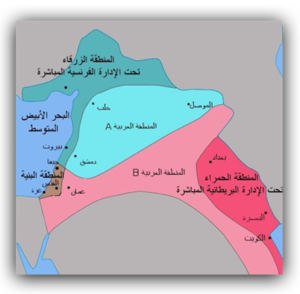
French and British Spheres of Influence and Control in the Levant and Iraq Following the Sykes–Picot Agreement
Contrary to the substance of the correspondence between Sharif Hussein and McMahon concerning the establishment of an Arab state, the signing of the secret Sykes–Picot Agreement on May 16, 1916, resulted in the division of the Arab territories of the Ottoman Empire, including the Levant, between Britain and France.
As the mandatory powers over the territories of the Levant, Britain and France concluded an agreement on March 7, 1923, to demarcate the borders between Palestine, Lebanon, and Syria. In practice, the boundary extended from the Mediterranean Sea to Al-Hamma, separating Lebanon and Syria to the north from Palestine and Transjordan to the south. The agreement included three detailed maps at a scale of 1:50,000. Known as the Paulet–Newcombe Agreement, it is regarded as an implementation of the secret Anglo-French agreement dated December 23, 1920, which sought to ease British concerns regarding French intentions toward Transjordan.
The Future of Transjordan and the End of Faisal’s Rule
July 25, 1920 – December 31, 1920
Following the end of Faisal’s rule, the French reassured the British that they would not extend their influence into Transjordan, even though the territory had been part of the Arab Kingdom under Faisal, and that they would respect the Sykes–Picot line. On December 23, 1920, a British-French agreement established the boundary between Syria and Transjordan.
Although High Commissioner Herbert Samuel supported extending British administration eastward to include the territory east of the Jordan River, the British did not wish to extend the administration of Palestine eastward, in an attempt to incorporate the territory into the proposed Jewish national home. British political advisers were sent to encourage local self-government in the three districts of Irbid, Salt, and Karak, which comprised the territory of Transjordan.
Within a few months, however, it became apparent that there was no alternative to establishing a centralized administration. Emir Abdullah arrived in Ma'an on November 21, coming from the Hejaz, and reached a preliminary understanding with Winston Churchill regarding Transjordan on March 30, 1921. He was appointed Emir of Transjordan, while Faisal became King of Iraq.
At the Jerusalem meeting, held from March 28–30, 1921, Britain stipulated that Emir Abdullah refrain from inciting Syrian refugees against the French in Syria and from undermining British control over Palestine. Churchill, for his part, confirmed that the provisions of the Mandate for Palestine would not apply to the territory east of the Jordan River.
On September 14, the Secretary-General of the League of Nations submitted to the Council a British memorandum outlining the steps proposed by the British government to implement Article 25 of the Mandate for Palestine. The memorandum described the boundaries between Palestine and Transjordan and listed the provisions of the Mandate for Palestine that excluded Transjordan from the Zionist project. These included part of the preamble and nine articles, either in whole or in part. In practice, these provisions primarily concerned the establishment of the Jewish national home.
On September 16, the Council of the League of Nations approved the British memorandum.


Comments