
al-Ashrafiyya
Updated: Aug 10

The Baysan–Jericho main road passed about 2 kilometers east of the village, and a secondary road connected the village to this highway. During the British Mandate, the village was classified as a farm according to the Government of Palestine Village Statistics (cited in the Palestine Index Gazetteer).
The residents of Al-Ashrafiyya were Muslims. Their houses were closely clustered, separated by narrow alleyways. Most of the land was cultivated, thanks to the availability of rainfall, natural springs, fertile soil, and the flat terrain that facilitated plowing. The main crops were vegetables and fruit trees, particularly citrus, bananas, and olives.
In the 1944–1945 statistics, 143 dunums were allocated to citrus and bananas, 7 dunums to grains, 4,458 dunums were irrigated or used for orchards. Most of the villagers worked in agriculture and poultry farming.
Occupation and Depopulation
Units of the Golani Brigade launched a raid and occupied the village on May 10–11, 1948. This raid marked the beginning of the broader offensive on Baysan, which took place the following day. The nearby village of Faru’na, also part of the Baysan subdistrict, was captured at the same time. Both villages were likely among the eight Arab villages near Baysan that, according to an Associated Press report, were captured by May 13.
Historian Benny Morris, citing Israeli sources, notes that the residents of Faru’na fled eastward across the Jordan River as Israeli forces advanced, and that Haganah engineering units began demolishing the village immediately after its capture.
The military campaign that led to the occupation of the Baysan Valley and the displacement of its population was named Operation Gideon, executed by the Golani Brigade between May 10 and 15, 1948, just before the declaration of the State of Israel. The Irgun militia may have participated in this offensive, having declared on May 14 that it had taken five Arab villages in the north.
The Village Today
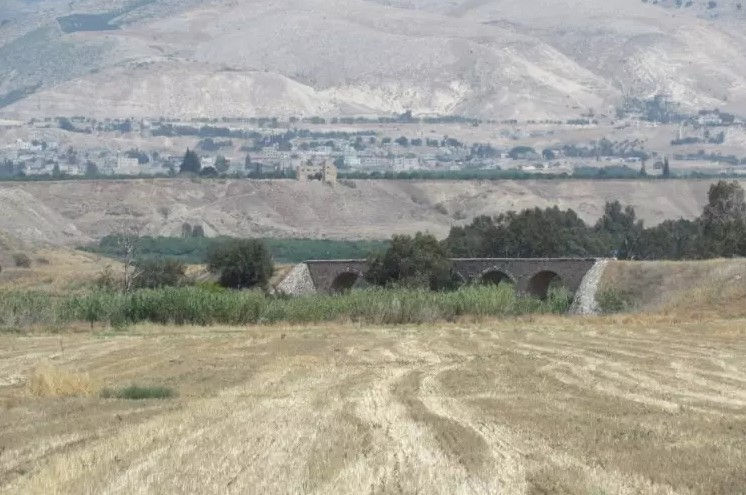
Currently, the site and surrounding lands are cultivated by residents of the nearby settlement of Reshafim. A fish farming pond has also been constructed on the site.
Zionist Settlements on Village Lands
The settlements of Shafa’im (195209) and Shluhot (105208), both established in 1948, are located on the lands of the village to the east of the original site.


Comments